Sometimes when you start teaching in Korea for the first time, lesson planning, pacing lessons and scheduling can feel daunting. So we have decided to tap into our teaching experiences to help you organise your lessons effectively.
Throughout this post, I will be using the 'writing star level 1' textbook as an example. I used this book when I was a teacher and you can find the pdf of the textbook for free here.
To start with: Lesson Planning.
When you have a textbook in front of you, planning what to do when and how to make it interesting for the students can be a big task. However, breaking it down into chapters based on the amount of time you have can really help.
Let's take an example: Writing Star 1 (3rd Edition).
This textbook has 8 chapters and most semesters have 13-16 weeks depending on the school. This book has 8 chapters so we can split the chapters in half. If you start teaching your class on the 1st December, your schedule could look something like this:
Week 1 (Week starting 1st December): Chapter 1 (pages 6-11)
- Homework is page 10-11
Week 2: Chapter 1 (pages 11- 15)
- Homework is page 15
To plan Week 1, you should focus on vocab and introducing the topic to the students.
To start, I would write the main words on the board and get the children to read it out loud. I would then integrate common questions that use these words as their answers.
For example, who do you live with? (I live with my dad, my mum and my sister).
How old is your sister? (My sister is 8 years old.)
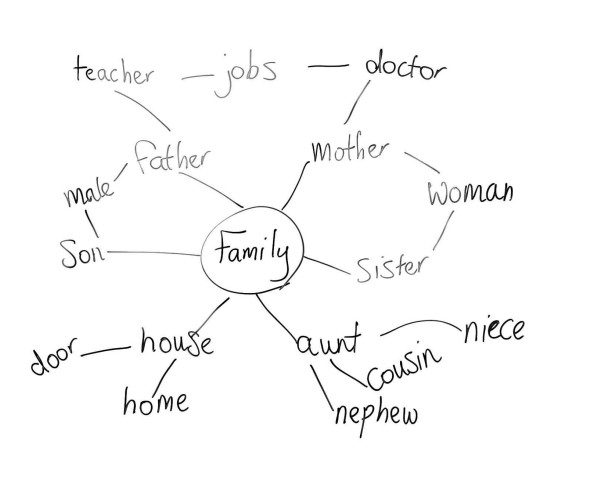
Then once you think that the students understand all the questions and words, you can play a game of word association (this is more catering towards elementary school students). You write a word in the middle of the board and invite the students to come and write a word on the board that relates to that word.
For example, family would be associated with words like, sister, brother, house, siblings etc.
It can be stylised how you want using the resources available. When I taught, I stylised it like a spider diagram:
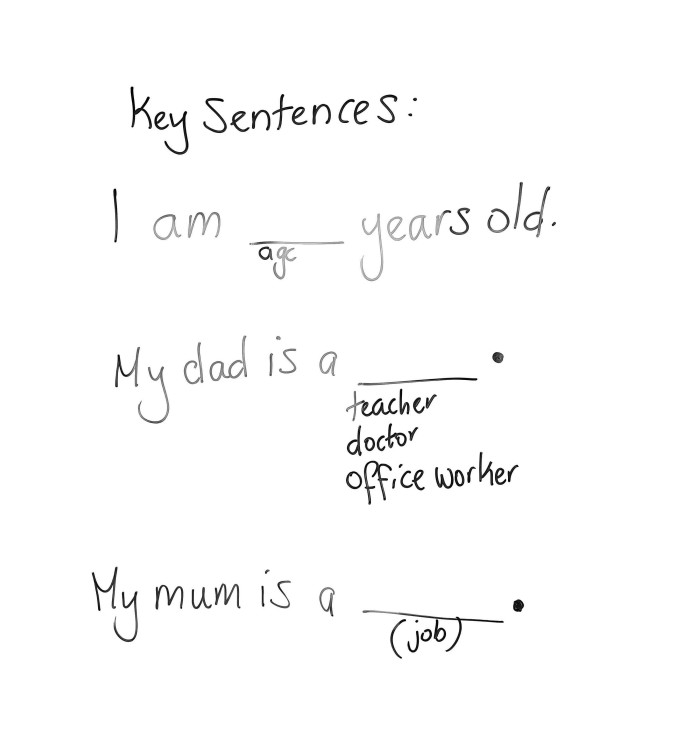
Secondly, after establishing these words, you can move onto the next page and introduce jobs and ages. Another method of teaching this is through call and response. You choose a student and ask the question, 'how old are you?' and they would respond 'I am 8 years old' or 'I am in the 3rd grade'. If the children are struggling with these sentence structures, you can write them on the board and leave the varying ages as blanks. For example:
I am ___ years old.
My dad is a ____. My mum is a ______. (jobs)
Job vocabulary can be difficult, so if your school allows you to, I would recommend using a small part of the board to write the job and the Korean, like so:
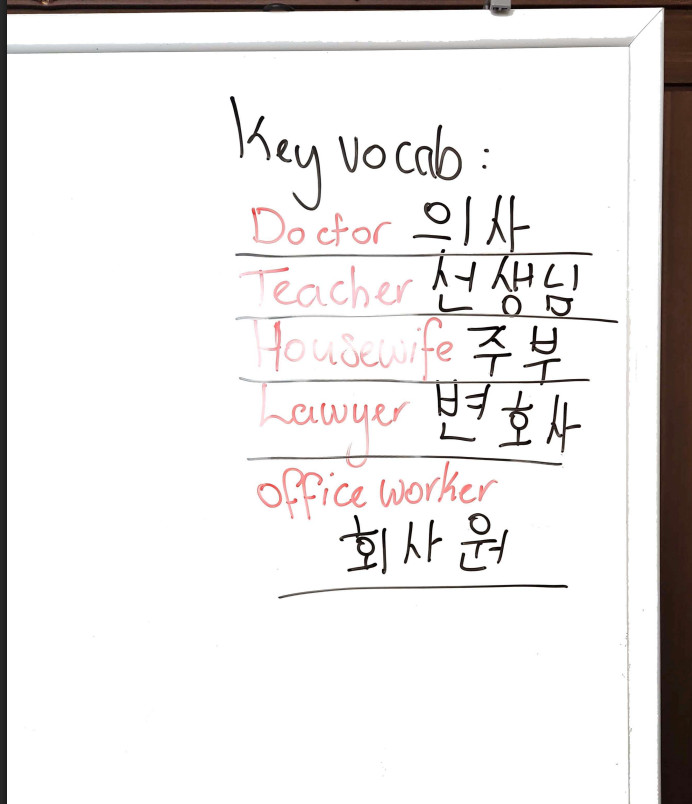
If they are still struggling, you can include options under the blank:
I am ____ years old.
(eight, seven, six)
My dad is a _____.
(doctor, teacher, baker)
After establishing this, you should combine the first two sections together to make a short paragraph. This is where the students would write on a piece of paper or in their books a short introduction, as follows:
Hello, my name is ____. I am ____ years old. I live with my family/ I live with my mum, dad, sister and brother. My dad is a doctor and my mum is a engineer.
After this, using the story in the textbook, go around the room and ask each student to read a sentence. When this is done, they can answer the true and false questions alone and then once all the children are done, you can go through the answerds together. If a student is quicker than others, you can ask them to go through the story and highlight words they do not know and/or translate the true/false sentences into Korean.
The next page can be done alone. If the students are struggling with the vocabulary, as with the jobs, you can take a part of the board to write the English and Korean.
If you don't have a smart board, it is good to draw (or attempt to!) the pictures to aid with picture/word association. Even you can't draw, the drawings being bad and funny can help with them learning the words.
Another way to teach the words, first, second, third, fourth etc is to draw a timeline/sequence on the board so they can see that first means 1 etc.
Their homework can be pages 10-11. If they are struggling, they can use the previous story to help them with the sentence structure/word order.
Week 2: Chapter 1, pages 11- 15.
First, write out all the words on the board that you identified in the previous lesson that the students struggled with. You can also do this with the sentence structuring.
After doing that, get the students do complete page 12 while you go around the classroom and check their homework. If there are sections that the student struggled with/needs to do again/did not complete, using post it notes to mark where they need to complete for their next homework helps.
When all the students are finished and you have marked the homework, write the sentences from page 12 onto the board and go around the room and ask each student in turn to fill in one of the blanks. If you have more students than blanks, you can get another student to read out the whole sentence after the blanks have been filled.
Then they can complete page 13 alone. While they are doing this, you can draw the diagram from page 14 onto the board and write some title ideas that the students can use. if you have more time, you can get the students to come up with their own ideas on the title of the essay and what words they learnt through the word associate task in the previous lesson (e.g. title: I live with my family, What jobs my parents do).
Then again, the students can complete this alone and you can go around the room and check. If they complete this too quickly, you can ask them to add more apples to the diagram with other family members (sister, brother, uncle etc).
Then you can assign their homework and the chapter is finished. If there is still more time, you can play hangman with the vocab from the chapter or pictionary.
For example:
1:00pm to 1:10pm- Getting the students settled, writing the date and introducting the topic.
1:10pm-1:30pm- Reviewing vocabulary and starting to complete the textbook activites.
1:30pm to 1:45pm- Finish the pages assigned for that class and review vocab with the children
1:45pm to 2:00pm- Writing down the homework and marking last week's homework. Vocab review with any words you identified as the children struggling with throughout the lesson.
It doesn't have to be anything complicated. What is the most important thing is that you understand the structure and it is easily useable in class.
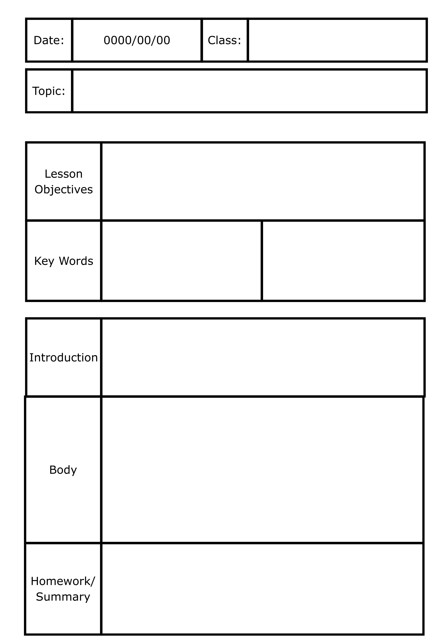
Second: How to structure your whiteboard.
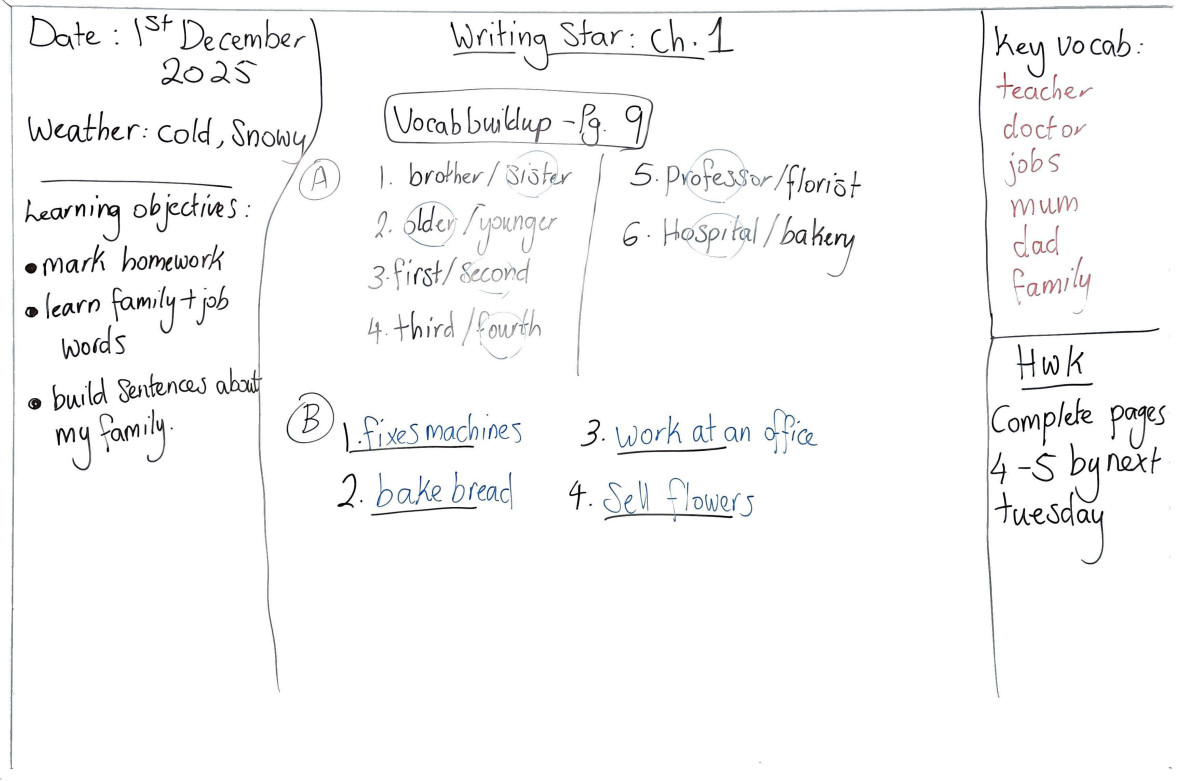
Although overlooked by some, how you write and the colours you use are very important, especially for students who are visual learners. When I was a teacher, each whiteboard colour was associated with a certain element of ESL. For example, grammar was blue, vocab was red, black for general information and green for answers.
This colour-coordinating was used by all teachers in every class, so whenever the students saw blue they knew it was a grammar point.
In terms of dividing out your board, you can do as below.
Naturally this can be adapted to what your schools asks you to cover. For example, when I taught elementary students, we would talk about today's weather and I would include that under the date. However, for middle school students, we would talk about the main news article of the day instead of the weather.
Third: Creating a schedule
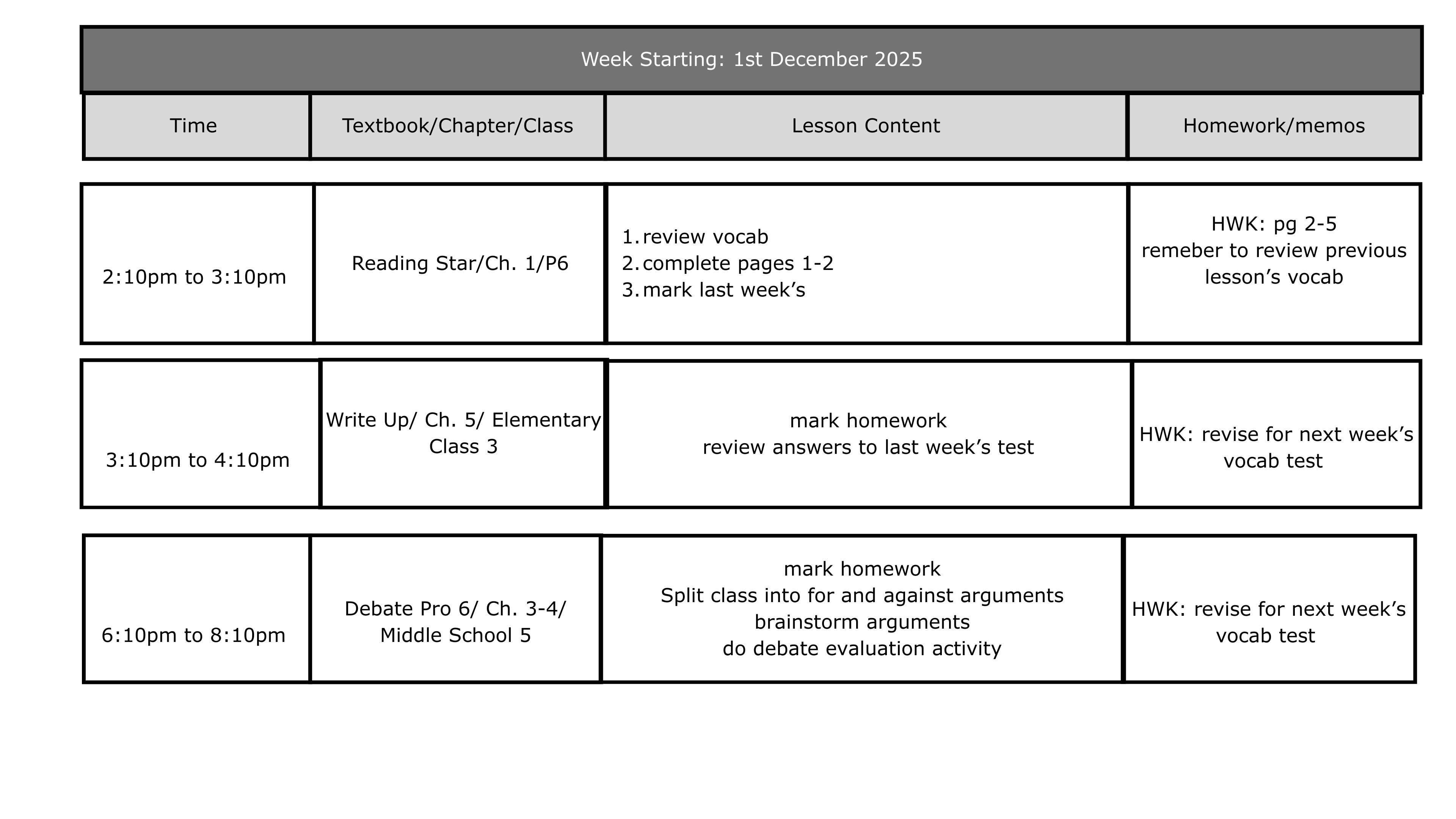
You can use a calendar app or just a calendar on a piece of paper to do this. We would have day structures given by our school to use which looked something like this:
Just keeping organised and on top of your work is a priority. Having a small notebook you can put into your pocket to track your to-do list is also an option.
There are also some websites that can help you in planning but also coming up with ideas on different activities to do with your students:
TES: https://www.tes.com/teaching-resources
Cambridge English: https://www.cambridgeenglish.org/educators-organisations/resources-for-teachers/
Grammar Monster: https://www.grammar-monster.com/
British Council: https://www.teachingenglish.org.uk/
TAGS
Share

Embark Recruiting Blogs
Embark Recruiting
As former native English teachers in Korea, we know exactly what it’s like to navigate teaching abroad. That’s why we’re committed to increasing transparency in schools and improving Korea’s ESL teaching industry. At Embark Recruiting, we provide full support to help you succeed. Our blogs offer guidance, tips, and insider knowledge for teaching in Korea.